Skip to content
Altamont Advisory
Altamont Digital

Altamont Advisory · Arm 03 · Decision-grade intelligence

AI & Digital

Decision-grade intelligence leadership can defend — governed, used, and left with your teams.

Not demo-room models. Intelligence that holds under capacity, bandwidth, politics, and multi-partner pressure. Same quality bar as Core Advisory and EdWorX.

Decision-grade intelligence · IMP residual capacity · peer arm to Advisory & EdWorX

Institutional weight

Built for material mandates

Depth across multi-country portfolios — Africa, Southeast Asia, and complex delivery environments.

950+

Institutional assignments

100M+

People reached

150+

Countries of delivery

300+

Specialists deployed

Shortlist materials for procurement and evaluation committees.

Download capability statements

Capabilities

What we own

Decision-Grade Intelligence

Intelligence shaped around the next decision — not dashboards that die after the pilot.

  • Decision-linked data products and performance intelligence
  • Portfolio analytics under multi-partner constraints
  • Utilisation design: who uses the insight, when, and why

Applied AI for Institutions

AI for institutional purpose — governed, auditable, fit to real risk and capacity.

  • Use-case prioritisation against real decisions and risk
  • Workflows for operational teams — not lab demos
  • Human-in-the-loop patterns for high-stakes settings

Data Architecture & Governance

Foundations that make intelligence trustworthy — and sustainable after close-out.

  • Architecture and interoperability for multi-system environments
  • Governance, stewardship, and quality frameworks
  • Indicators, metadata, and institutional standards

Digital Delivery That Holds

Platforms and operating models built for bandwidth, capacity, and adoption politics — including IMP as the four-domain workspace where residual capacity matters.

  • Platform strategy for institutional scale
  • IMP: delivery, MERL/results, evaluation, and finance (EMS) — multi-tenant; human Accept gates; residual capacity under Implementation Integrity
  • Low-bandwidth and access-constrained delivery

Four-domain workspace · Altamont Digital

Impact Management Platform (IMP)

IMP is one multi-tenant workspace covering four domains: delivery, MERL/results, evaluation, and finance (EMS) — with shared people, programmes, and organisation boundaries so one tenant never sees another’s data.

Delivery holds people and purpose-based consent (grant/revoke), enrolment, activities, milestones, evidence, import, and roles. Results & learning hold outcomes → indicators (baseline / target / actual), learning log, inquiries, and reports/exports. Evaluation is a workhorse: evaluation programmes; TOR/proposal to design draft; human Accept gates; evidence events; governed findings and recommendations; client packs (board / HTML / PPTX-style outputs as implemented). Finance (EMS) covers staff claims, approvals, vendors/AP, and reports — organisation-scoped.

AI may draft designs and packages; humans Accept design and client packs — there is no silent publish-as-truth.

Structures, indicators, and findings trails remain with the organisation after close-out. Residual capacity under Implementation Integrity means the workspace still works when advisors are no longer in the room.

IMP is not a replacement for field work or independent professional judgement. It is not an offline mobile field app, not a cross-org data marketplace, and not automated final evaluation without human Accept.

Consultants and contractors: learn about IMP packages and join the Partner programme.

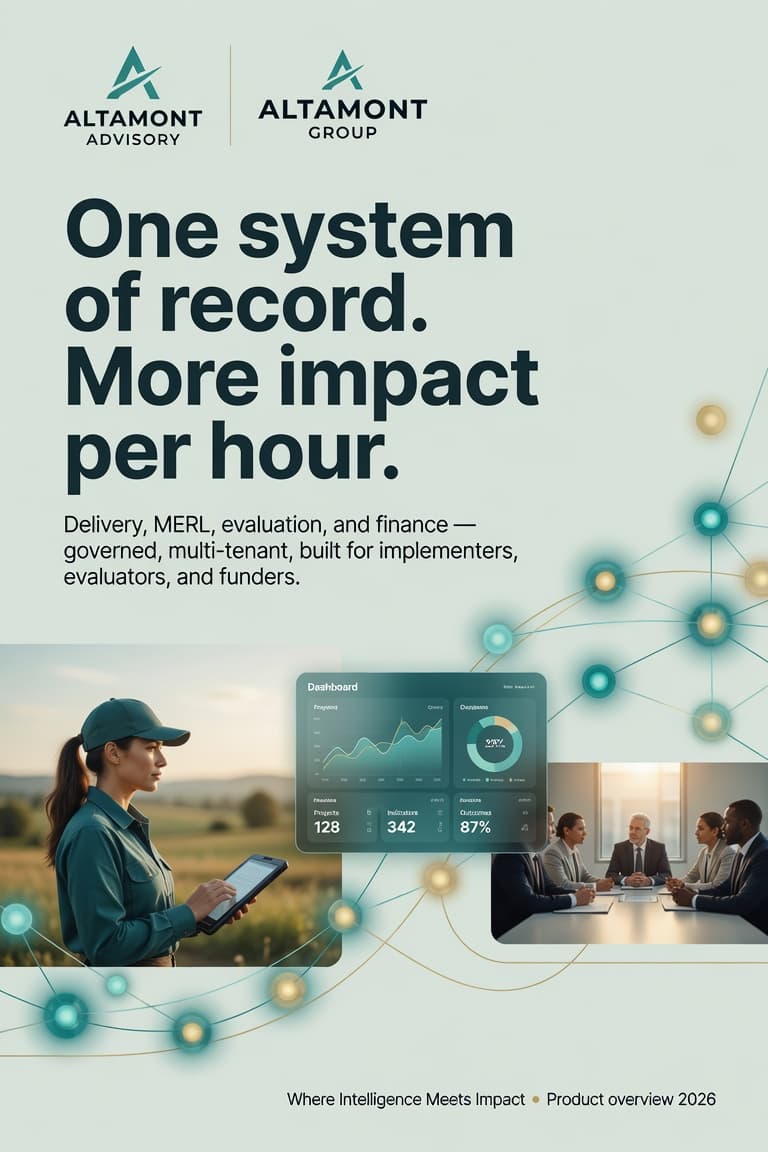
One system of record — more impact per hour
One system of record. More impact per hour — residual capacity stays with the host organisation.
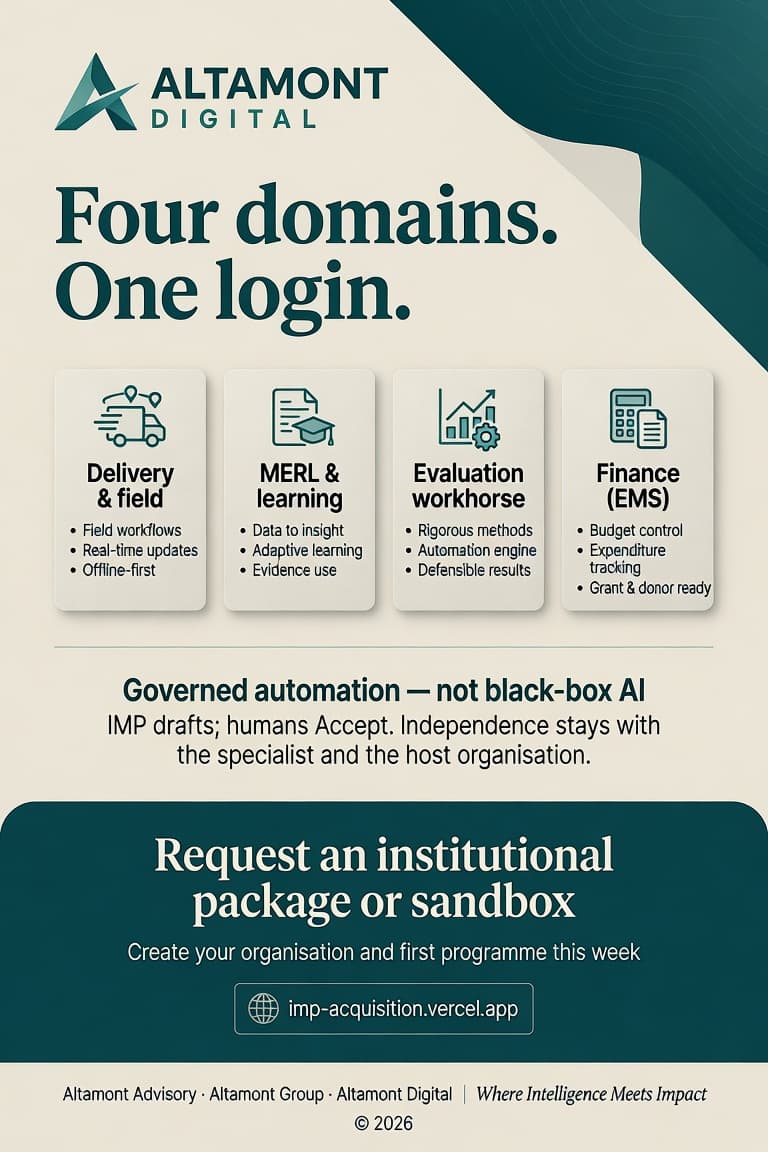
Four domains. One login.
Four domains. One login — delivery, MERL, evaluation, finance. AI drafts; humans Accept.

Full product storyInstitutional packages

What IMP does

  • Core

    One multi-tenant workspace

    Four domains — delivery, MERL/results, evaluation, and finance (EMS) — sharing people, programmes, and organisation boundaries. Strong tenant isolation.

  • Delivery

    Delivery

    People and purpose-based consent (grant/revoke), enrolment, activities, milestones, evidence attachments, import, and roles (Admin / Staff / Viewer).

  • MERL / results

    Results & learning

    Outcomes → indicators with baseline, target, and actual; learning log; inquiries; reports and CSV exports for programme and donor review.

  • Evaluation

    Evaluation workhorse

    Evaluation programmes; TOR/proposal → design draft; human Accept gates; evidence events; governed findings and recommendations; client packs (board / HTML / PPTX-style as implemented).

  • Finance · EMS

    Finance (EMS)

    Staff claims, approvals, vendors/AP, and reports — organisation-scoped accountability finance on the same workspace.

  • Governance

    AI drafts · human Accept

    AI may draft designs and packages; humans Accept design and client packs. No silent publish-as-truth.

  • Residual capacity

    After close-out

    Structures, indicators, and findings trails remain with the organisation — Implementation Integrity when advisors leave.

  • Honest boundary

    What IMP is not

    Not a replacement for field work or independent professional judgement; not offline mobile field capture; not automated final evaluation without humans; not a cross-org data marketplace.

Product evidence

Live UI from the platform — consent, utilisation, and vendor control as teams actually use them. Tap or click to expand.

Who it is for

  • Programme teams that need one organisation-scoped system of record
  • Institutions that want IMP as digital backbone under a MERL / advisory mandate
  • Teams that need a product licence without a large advisory engagement

How to engage

Same quality bar. Two ways to buy: formal mandate / RFP, or frictionless packaged entry via the acquisition desk (fixed pilot + clear Year-1 packages). First clear packaged path of this kind for institutional MERL advisory — procurement-efficient, not consumer SaaS.

Why this is better for you

A frictionless buying system for institutional MERL advisory — transparent packages and fixed-fee pilot entry under the same Implementation Integrity standard. Formal RFP remains available when your process requires it.

  • Transparent fees before you commit
  • Scope clarity in days, not months
  • Pilot credit toward Year-1
  • No requirement to run a full RFP for the right-sized engagement
  • Same residual capacity standard as our larger mandates

Diagnostic sample — not a free pilot

See how your programme data would look in IMP

Board-style thinking: on-track / at-risk / behind, target vs actual.

Share a sample extract (up to ~100 rows). We map people, programmes, activities/indicators where the file supports it and return a short note on fit and gaps (including consent and duplicates).

You will hear from us within 2–3 business days.

Who we serve

Institutional decision-makers

  • Government ministries and public institutions
  • UN agencies and multilateral programmes
  • International NGOs and foundations
  • Multi-country portfolios needing decision-grade systems

Selected work

Outcomes leadership can defend

All proof →
AI & DigitalHumanitarian & Development

Multi-region · multi-partner portfolio

Outcome leadership defended

A decision-linked intelligence product and utilisation cycle the board actually used — with clear ownership, refresh cadence, and governance so the system remained after the engagement.

Pressure

A multi-country portfolio board could not compare performance across partners or defend reallocation mid-cycle. Dashboards existed; utilisation did not. Leadership risked deciding on politics rather than governed evidence — while country teams waited for a signal they could act on.

Discuss similar work →
AI & DigitalGovernance

High-stakes institutional setting

Outcome leadership defended

Prioritised use-cases tied to real decisions, human-in-the-loop patterns, and a governance frame the institution could defend and sustain.

Pressure

Leadership wanted AI productivity gains without accepting uncontrolled model risk, weak data foundations, or tools staff would abandon after a pilot — under capacity and political scrutiny.

Discuss similar work →

One practice

Combine arms when the mandate requires it

Next step

Brief us on the intelligence or systems mandate

Data landscape, digital constraint, IMP as backbone under advisory, pilot discussion, or board decision under pressure. Response within two business days.

Download capability statements